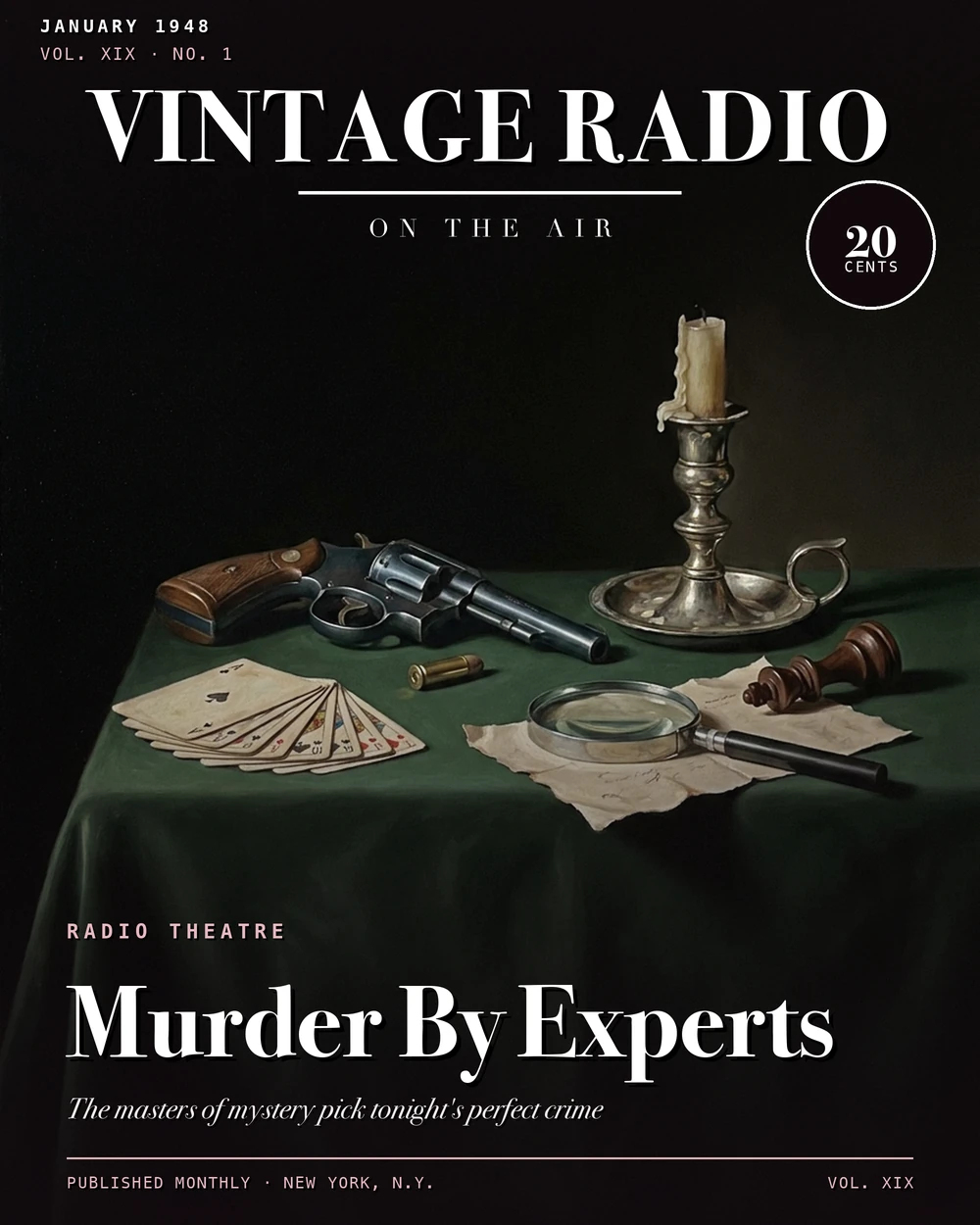
Murder By Experts
A Mystery Show Built Around the Writers, Not Just the Stories
What set Murder By Experts apart from the crowded field of mystery radio in 1949 wasn't just its stories — it was the idea of building each episode around the taste and judgment of a real mystery writer. Every week, a guest author hand-picked a story for broadcast, with the host stepping in to make the introduction. The result was a Crime-Detective program that wore its literary credentials openly, and the Mystery Writers of America noticed. After just six months on the air, the show took home the Edgar Award for Best Mystery Radio Program in 1950, with the trophy formally presented on the April 24, 1950 broadcast. That's an unusually short runway to earn that kind of recognition.
The show ran on the Mutual network from June 18, 1949 to December 17, 1951, producing 130 episodes across a schedule that shifted around considerably in its early months — Saturday afternoons at 2:30 through July 1949, then Sunday nights at ten until September, then Monday nights at nine. It originated from Mutual's flagship station WOR in New York City and drew its cast entirely from New York radio personnel. The show was sustaining — unsponsored throughout its run — which gave it a certain freedom from the advertiser pressure that shaped so many of its counterparts.
How the Show Was Put Together
Creator and writer David Kogan built the format around a rotating panel of mystery fiction hosts and an open invitation to guest authors to pick their favorite stories. The host's job each week was to open with something like "This week's show has been chosen for your approval by one of the world's leading detective writers," then name the story, its author, and the guest making the selection. At the close of each episode, the narrator returned to give the title again and preview the following week's drama. It was a clean, reliable frame — and it let the show signal its seriousness without having to argue for it.
Guest experts who selected stories for broadcast included Craig Rice, Bruno Fisher, Lawrence Blochman, Dorothy Salisbury Davis, and Hugh Pentecost. These were working writers choosing stories they personally vouched for, which gave the selections a different weight than a producer simply pulling scripts from a pile. Kogan knew mystery radio from the inside; he also wrote scripts for The Mysterious Traveler, Nick Carter Master Detective, and The Sealed Book.
Producer-director Robert A. Arthur handled the production side, with Kogan sharing those duties. Music came from Emerson Buckley, a New York conductor and musical director who worked extensively in radio; the Edmund Hall Trio contributed on at least some episodes. Mario Siletti was on sound effects, and Phil Tonkin served as announcer. The regular cast pool included Lawson Zerbe, Ann Shepherd, Santos Ortega, Ralph Bell, and William Zuckert, with at least one writer — Joseph Ruscoll — contributing scripts with a notably lighter touch than the show's prevailing tone.
The Hosts: Carr and Halliday
John Dickson Carr was the initial host, and he was genuinely well cast. Born in Uniontown, Pennsylvania in 1906 — the son of a U.S. congressman — Carr had graduated from Haverford College in 1929 and then spent years living in England, marrying an Englishwoman and steeping himself in the British puzzle-mystery tradition. His locked-room novel The Hollow Man (1935) was voted the best locked-room mystery of all time in 1981 by a panel of seventeen mystery writers and reviewers, and his 1948 biography of Sir Arthur Conan Doyle had already earned him a Special Edgar Award from the MWA in 1950 — the same ceremony that honored Murder By Experts. He had also shown he could write for radio, having created all 23 scripts for the CBS series Cabin B-13 in 1948–49. When Variety reviewed the premiere of Murder By Experts, the trade paper called it "a slick moderately-budgeted whodunit with good scripting and production values" and specifically noted that Carr "brought a warm, informal manner to the role of host." That warmth mattered — the format asked listeners to trust the host's judgment, and Carr carried that easily.
Brett Halliday took over later in the series. Halliday was the pen name of Davis Dresser, born in Chicago in 1904 and raised in West Texas, who at thirteen was thrown into a barbed-wire fence by a horse and lost most of the vision in his left eye, wearing an eye patch for the rest of his life. Dresser had created the hard-boiled private detective Michael Shayne, whose adventures ran across more than 70 novels estimated to have sold between 65 and 75 million copies worldwide. He was also one of the founding members of the Mystery Writers of America in 1945, which made him a natural fit for a show built on the MWA's aesthetic values. Because "Brett Halliday" was a pen name later used by multiple ghostwriters, there's been some speculation about whether Dresser himself voiced the host role or whether an actor stood in — though Dresser was actively writing during the period. Alfred Hitchcock also served as host at some point in 1951, adding further marquee weight to the show's final year.
What Made the Stories Work
The plots on Murder By Experts were described in the show's own promotional framing as "highly charged stories of crime and passion." What that phrase points at is something real: the show's stories turned on emotion rather than gimmicks. These weren't puzzle mysteries where the audience was meant to track red herrings and beat the detective to the answer — they were crime stories grounded in character and feeling, the kind of tale a working mystery writer would actually admire rather than just consume. The available episodes come across as straightforward and honest, with the show holding up better than most of its counterparts in the genre. The Variety endorsement at launch suggested the scripts lived up to that promise from the start.
Arthur, Kogan, and the Edgar Award Years
Robert Arthur Jr. brought an unusual background to the production table. He was born at Fort Mills on Corregidor Island in the Philippines in 1909, while his father was stationed there as a U.S. Army officer. By the time he was working on Murder By Experts, he had written more than 500 radio scripts across his career. He and Kogan had previously been nominated for the Edgar Award for Best Radio Drama in 1949 for their work on The Mysterious Traveler, losing that year to Inner Sanctum Mysteries. The 1950 win for Murder By Experts made good on that earlier near-miss.
In 1951, the two men received a third Edgar — this one for "outstanding achievement in producing, directing and writing radio mystery shows" — recognizing their combined work on both Murder By Experts and The Mysterious Traveler. That same year, both shows were runners-up for Best Mystery Radio Program, suggesting the two productions were competing with each other for the top spot even as they shared the same creative team.
Arthur later moved to Hollywood in 1959, writing scripts for The Twilight Zone and Alfred Hitchcock Presents, and went on to create The Three Investigators young-adult novel series. Kogan's post-radio work is less documented, but his contributions to the format of Murder By Experts — the rotating host structure, the guest-expert selection process — were distinctive enough to earn the show its place in the Edgar record.
How It Ended
Murder By Experts closed out on December 17, 1951, after two and a half years and 130 episodes. The show was part of a two-hour block of four mystery programs that Mutual assembled at the time — a block-programming approach that put Murder By Experts third in the lineup each week. Going out as an unsponsored show, it never had the commercial infrastructure to guarantee a long run, and the end came without particular fanfare. What it left behind was a body of work that held up: a Crime-Detective series that earned the respect of the very writers it invited on as guests, won the top award in its field before its first year was finished, and, by most accounts, delivered on the promise of its format week after week.